The last couple of years have not been easy either for the consumers or for the manufacturers. The COVID pandemic brought numerous political and economic challenges which were felt in all businesses. These were further complicated by the Russian aggression in Ukraine and by the inflation wave which hit Europe in 2023. The chart below shows the development of food prices in the EU (blue line) and Austria (green line) expressed in constant 2015 prices. In other words, if you lived in Austria and you were paying for your weekly basket of purchases 100 EUR in 2015, you would pay 109 EUR in October 2020, 121 EUR in June 2022 and 133 EUR in May 2023.
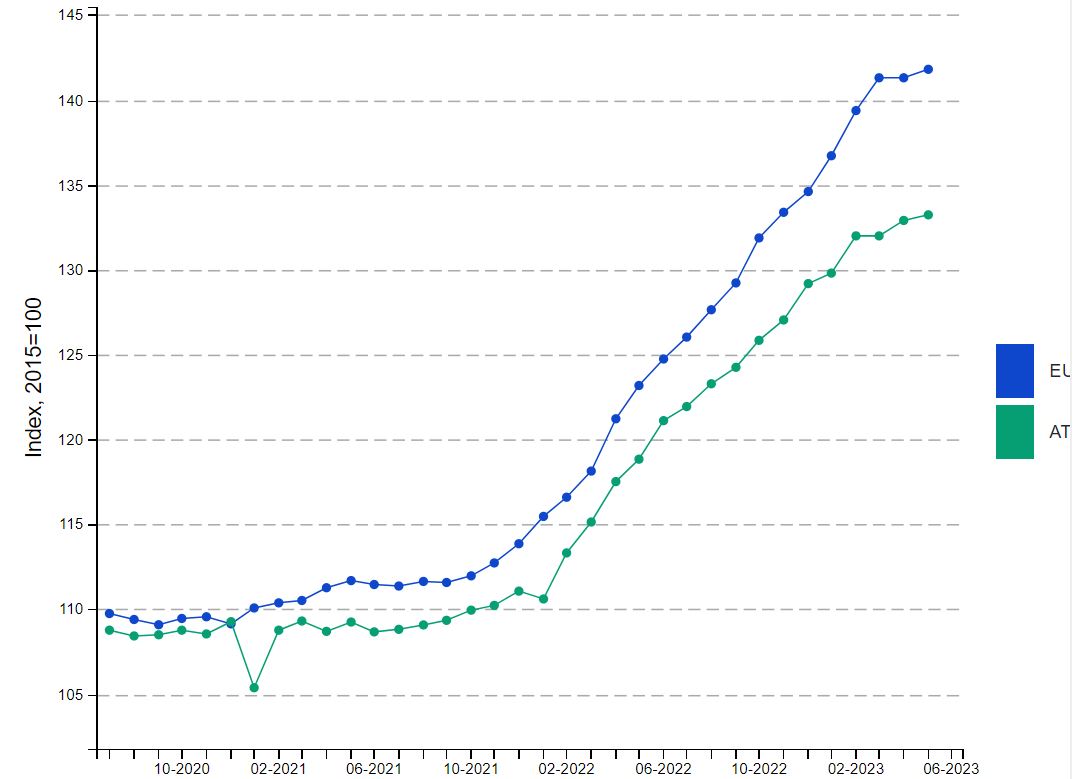
Source: Eurostat
Needless to say, this immediately caused a concern and a very negative reaction among consumers who were trying to understand from where this increase came and – it is a normal and expected human reaction – who was to blame. Retailers have been in the crosshairs of media and rumors as possible perpetrators and have had to deal with a very negative and hostile public relations environment. Of course, the real reasons for inflation of food prices went much deeper than a simple “bad retailer is raising the prices” narrative but this was the reality their communication teams had to operate in. Some of them fared better than others and I am going to give such an example here.
I was at the check out of our neighborhood SPAR shop when I saw this A4 sheet printout facing all customers at a very prominent place – they could not miss it.
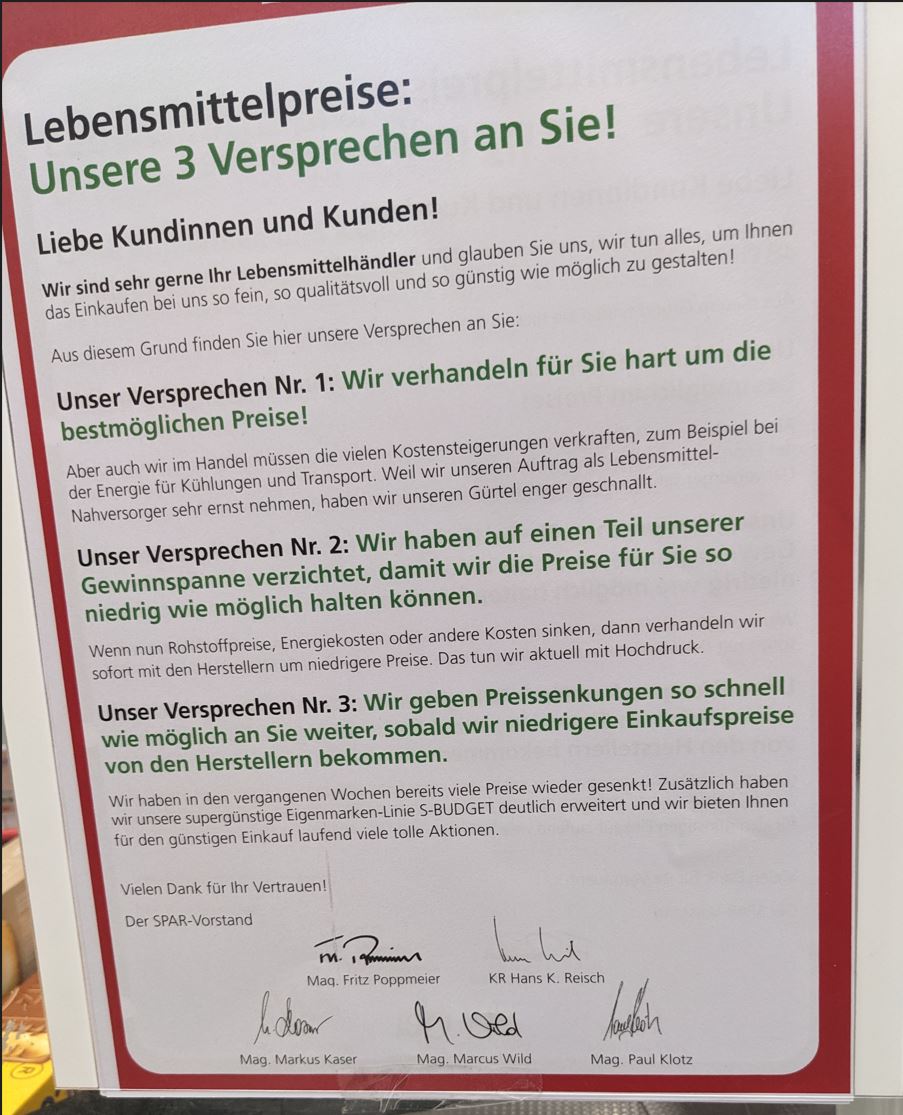
Here is the text in English:
Food prices: Our 3 promises to you!
Dear customers!
We are very happy to be your grocer and, believe us, we will do everything to make your shopping experience with us as fine, as high quality and as affordable as possible!
For this reason, here are our promises to you:
Our promise N 1: We negotiate hard for you to get the
best possible prices!
But we in the trade also have to cope with the many cost increases, for example in energy, for refrigeration, and for transport. Because we take our mission as a local food supplier very seriously, we have tightened our belts.
Our promise N 2: We have given up part of our profit margin so that we can keep prices as low as possible for you.
If raw material prices, energy costs or other costs fall, we immediately negotiate with the manufacturers for lower prices. We are currently doing this at full speed.
Our promise No. 3: We will pass on price reductions to you as soon as possible as soon as we get lower purchase prices from the manufacturers.
We have already lowered many prices in the past weeks! In addition, we have significantly expanded our super-affordable private label line S-BUDGET and we are offering you many great promotions for low-price shopping on an ongoing basis.
Thank you for your trust!
The SPAR Board
I was quite impressed with this message and I took a picture of it (luckily neither the queue nor the cashier objected). The message has three important components:
1. It is brief and up-to-the-point. When you are at the check out of a supermarket you have neither the time nor the desire to read long messages. This one uses short and uncomplicated sentences which successfully deliver a simple message – we are on your side and we will do our best to support you in these difficult times.
2. It concentrates only on the points that are relevant for the customer. The message does not engage in explanations and excuses; instead, it lists only three actions which SPAR promises to actually DO. These are easy to follow, understand, and remember.
3. It lists not only promises but also current actions. It is very important for customers to understand what SPAR is actually doing to deliver on these promises.
Because of these three components the message comes through as honest and unscripted. I personally believed in it, and I am not the easiest guy to convince. This is why I will continue shopping in my SPAR shop.